A car accident can happen in seconds, but determining who is legally responsible can take much longer. In Houston, collisions involving distracted driving, speeding, unsafe lane changes, and failure to yield often leave drivers dealing with injuries, vehicle damage, medical expenses, and insurance disputes.
One of the biggest questions after an accident is: What happens if more than one person contributed to the crash?
Texas law recognizes that responsibility for an accident can be shared. This means an injured person may still have the right to pursue compensation even if they were partially responsible, depending on the circumstances.
Understanding how shared liability works can help protect your rights and prevent insurance companies from unfairly shifting blame.
If you have been injured in a Houston car accident, speaking with a knowledgeable Houston African American Personal Injury Attorney can help you understand your legal options and determine what steps may be appropriate.
What Is Shared Liability in a Houston Car Accident?
Shared liability occurs when more than one person contributes to an accident. Rather than automatically assigning all responsibility to one driver, investigators, insurance companies, and courts may evaluate the actions of everyone involved.
For example, imagine a driver traveling through a Houston intersection when another motorist makes an unsafe left turn. The second driver may have caused the collision, but an investigation could reveal that the first driver was also speeding.
In that situation, both drivers may share some responsibility.
Texas uses a legal framework known as proportionate responsibility to determine how fault affects a person’s ability to recover damages.
Understanding Texas’s 51% Rule
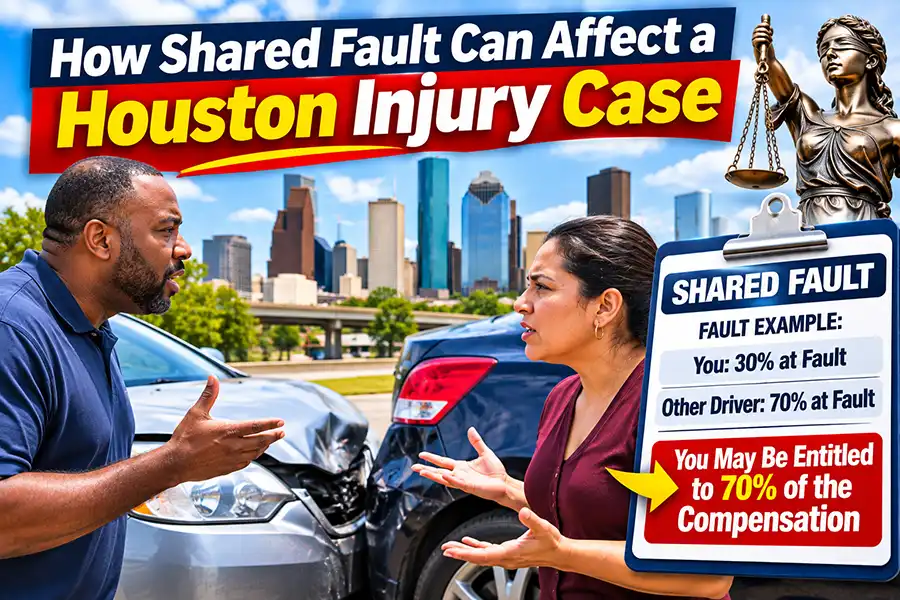
Texas follows a modified comparative responsibility system. Under Chapter 33 of the Texas Civil Practice and Remedies Code, an injured person generally cannot recover damages if their percentage of responsibility is greater than 50%.
If the injured person is 50% responsible or less, they may still recover damages, but the amount can be reduced according to their percentage of responsibility.
Consider this example:
A Houston driver suffers $100,000 in damages after a collision. An investigation determines that the other driver was 80% responsible and the injured driver was 20% responsible.
The injured driver’s potential recovery would be reduced by 20%, resulting in $80,000 before any other applicable legal considerations.
However, if the injured driver were found to be 51% responsible, the Texas proportionate responsibility rule would generally prevent recovery.
You can review the official Texas Civil Practice and Remedies Code, Chapter 33 for additional information.
Common Causes of Shared-Fault Car Accidents in Houston
Houston’s busy roadways, major intersections, and congested highways create many situations where multiple drivers may contribute to a collision.
Some common examples include:
1. Speeding and Unsafe Driving
A driver traveling above the speed limit may have less time to react to changing traffic conditions. However, another motorist who makes an unsafe turn or fails to yield may also contribute to the collision.
Investigators may examine vehicle damage, skid marks, roadway conditions, witness statements, and other evidence to determine responsibility.
2. Distracted Driving
Texting, adjusting navigation systems, eating, or using a phone can prevent drivers from noticing hazards.
When distracted driving contributes to an accident, it may become an important factor in determining liability.
3. Failure to Yield
Drivers must follow traffic signals, signs, and right-of-way rules. A motorist who turns across oncoming traffic or enters an intersection without yielding may cause a serious collision.
However, investigators may also consider whether another driver was speeding or otherwise operating a vehicle unsafely.
4. Unsafe Lane Changes
Houston highways can become especially dangerous when drivers change lanes without checking blind spots or providing adequate warning.
If one driver makes an unsafe lane change while another is following too closely, responsibility may be disputed.
5. Following Too Closely
Rear-end accidents frequently involve questions about following distance, speed, braking, and traffic conditions.
Although the rear driver may often be responsible, the facts of each accident must be examined before fault can be determined.
How Insurance Companies Determine Fault
After a car accident, insurance companies typically begin investigating the collision to determine liability and evaluate potential claims.
Their investigation may include:
- Reviewing police accident reports
- Examining photographs and videos
- Interviewing drivers and witnesses
- Inspecting vehicle damage
- Reviewing medical records
- Evaluating traffic and roadway conditions
- Examining available surveillance or dashcam footage
- Consulting accident reconstruction professionals
Insurance companies have financial interests in minimizing claim payments. As a result, an adjuster may attempt to assign a larger percentage of responsibility to the injured driver.
For example, an insurer may argue that you were speeding, distracted, or failed to react quickly enough. These allegations can affect the amount of compensation available under Texas law.
It is important to remember that an insurance company’s initial assessment is not necessarily the final determination of legal responsibility.
Evidence That Can Help Establish Fault
Evidence is essential when determining how an accident occurred and who contributed to it.
If you have been involved in a Houston car accident, useful evidence may include:
Police reports: Accident reports may contain statements, observations, diagrams, and information about the collision.
Photographs and videos: Pictures of vehicle damage, traffic signals, road conditions, and the accident scene can help explain what happened.
Witness statements: Independent witnesses may provide important information about driver behavior before and during the collision.
Medical records: Medical documentation helps establish the injuries sustained and the treatment required.
Dashcam and surveillance footage: Video recordings may capture the collision or events immediately before it occurred.
Vehicle data: Certain vehicles contain electronic information that may help establish speed, braking, or other driving activity.
Preserving evidence as soon as possible is important because video footage may be overwritten and physical evidence can disappear.
Can You Still Recover Compensation If You Were Partially at Fault?
Yes. Under Texas’s proportionate responsibility rules, an injured person may still recover damages if their percentage of responsibility does not exceed 50%.
Depending on the facts of the case, compensation may include:
- Emergency medical treatment
- Hospital and physician expenses
- Rehabilitation and physical therapy
- Future medical expenses
- Lost wages
- Reduced future earning capacity
- Physical pain and suffering
- Mental anguish
- Physical impairment
- Disfigurement
The amount potentially available depends on the evidence, the nature of the injuries, applicable insurance coverage, and other legal considerations.
An attorney can evaluate the facts and explain how shared responsibility may affect a particular claim.
Why You Should Be Careful Before Accepting an Insurance Settlement
Following an accident, an insurance company may contact you with questions or an early settlement offer.
Although receiving money quickly may seem helpful, accepting an offer before understanding the full extent of your injuries can create problems.
Some injuries take time to develop or become fully understood. You may need additional treatment, rehabilitation, or time away from work.
Before signing a settlement agreement, consider whether the offer accounts for your current medical expenses, future treatment needs, lost income, and other potential damages.
Once a settlement release is signed, you may give up the right to pursue additional compensation for the same accident.
What Should You Do After a Car Accident in Houston?
Taking the right steps after a collision can help protect your health and preserve information that may become important in a personal injury claim.
- Get medical attention. Seek emergency assistance when necessary and follow up with a medical professional.
- Report the accident. Contact law enforcement when appropriate and obtain an accident report.
- Document the scene. Photograph vehicle damage, road conditions, traffic signs, and visible injuries when it is safe.
- Collect witness information. Obtain names and contact details from people who witnessed the collision.
- Preserve records. Keep medical bills, repair estimates, insurance correspondence, and documentation of lost wages.
- Be cautious with insurance statements. Avoid guessing about fault or the extent of your injuries.
- Consider legal guidance. An attorney can help evaluate the evidence and explain your rights under Texas law.
Why Legal Representation Matters in a Shared-Liability Case
Shared-fault cases can become complicated when drivers disagree about what happened or when insurance companies dispute the percentage of responsibility.
A personal injury attorney may help by investigating the accident, collecting evidence, identifying potentially responsible parties, reviewing insurance coverage, communicating with insurance companies, and evaluating settlement offers.
For many people, finding a Houston African American Personal Injury Attorney is also about finding someone who values communication, respect, and personal attention.
Injury victims deserve to have their concerns heard and their circumstances carefully considered. An attorney should take time to understand how an accident has affected a person’s health, employment, family, and financial stability.
Lanease D. Fuller Law provides legal representation to individuals dealing with personal injury matters in Houston and surrounding communities. Learn more about the firm’s approach to personal injury cases in our article about Houston African American Personal Injury Representation.
Houston African American Personal Injury Attorney: Contact Lanease D. Fuller Law
If you have been injured in a Houston car accident, do not assume that being partially responsible automatically prevents you from pursuing compensation.
Texas law provides a framework for evaluating shared responsibility, and the facts of your accident matter.
Lanease D. Fuller Law understands the challenges that can follow a serious accident, including medical expenses, lost income, insurance disputes, and uncertainty about the future.
If you are searching for a Houston African American Personal Injury Attorney, contact Lanease D. Fuller Law to discuss your accident and learn about your legal options.
Visit Lanease D. Fuller Law or call 713-439-7400 to request a consultation.
Your rights matter. Get the information you need to make informed decisions about your next steps.
This article is for general informational purposes only and does not constitute legal advice. Every personal injury case is different, and legal outcomes depend on the specific facts and applicable law.